
Clothes only look as good as the care you put into them, and keeping garments wrinkle-free is one of those chores most of us keep putting off. But nobody wants to walk into a date or a job interview in a crumpled shirt or a limp saree pallu. In India specifically, the humid climate in most cities means clothes crease faster than they would in drier parts of the world — which is exactly why the neighbourhood presswala culture has thrived here for decades, and why so many households are now looking at electric alternatives to handle it themselves.
When it comes to caring for fabrics like tablecloths and curtains, most of us default to the traditional iron brands we grew up with. But there’s a second tool that’s been rapidly gaining ground in Indian homes — mostly because it’s more powerful, lighter, and often faster to use when you’re in a hurry.

We’re talking about the garment steamer and the iron. Both have real pros and cons, and if you’re stuck deciding between them, this guide breaks down exactly how they differ, what each one actually costs in India, and which one fits your wardrobe and lifestyle better. They share more or less the same end goal — wrinkle-free clothes — but they get there in very different ways.
Difference Between Garment Steamer & Iron
🌬️ Garment Steamer: Benefits & Disadvantages
A garment steamer is a multi-functional household appliance that removes creases from both delicate and heavy fabrics using moist heat rather than direct pressure. It’s also called a clothes steamer, and beyond de-wrinkling, it’s genuinely useful for sanitizing fabric — including mattresses, curtains, and upholstery.

A small internal tank holds cold water that heats up to produce steam. The real advantage here is that you don’t need an ironing board — clothes can hang on a rack, a door, or even the back of a chair, and you steam them vertically without ever pressing down on the fabric. That also means there’s no risk of accidentally scorching delicate material against a hot soleplate.
In India, garment steamers typically range from around ₹1,500 to ₹3,000 for a handheld model (1000W–1800W, 150–260ml tank), while full-size standing steamers with a garment hanger and larger boiler run from roughly ₹3,500 up to ₹15,000, depending on tank size and brand. Popular options in the Indian market include Philips, Havells, Usha, Inalsa, AGARO, and Black+Decker.
✔ Benefits
- Space-Saving & Convenient: A one-piece design that stores easily in a closet — no ironing board or pad needed.
- Efficient: Just hang the garment and run the steaming head over it. No repositioning or lifting on a board.
- Faster for Certain Fabrics: Since you don’t need to lay the fabric flat, a decent steamer can de-crease hanging clothes quickly.
- Sanitizing & Pest Control: The heat can kill some bacteria and pests in fabric — useful on mattresses for dust mites, or on curtains and upholstery.
- Safer on Delicate Fabrics: No direct hot-plate contact means less risk of scorching silk, chiffon, or embellished fabric.
❌ Disadvantages
- Less Sharp Look: A steamer relaxes fabric rather than pressing it, so it won’t give you that crisp, “fresh out of the laundry” crease an iron does. It’s excellent for reviving saree pleats, though.
- Not Ideal for Travel: Handheld models are portable, but standing steamers are bulky and impractical to carry.
- Can Cost More: Standing steamers, especially higher-end models, sit at a noticeably higher price point than a basic iron.
- Needs Some Preheat Time: Most handheld models take 30–60 seconds to start producing usable steam — quick, but not instant.
🔥 The Steam Iron: Benefits & Disadvantages
You’ve almost certainly used a steam iron before — they de-wrinkle crumpled clothes with a hot soleplate and a controlled burst of steam, giving you a crisp press without much fuss. Here’s the basic mechanics: the soleplate heats up, water in the internal tank drips onto it to generate steam through vents in the plate, and that steam softens the fabric fibers as the hot plate presses them flat.

Steam irons in India are widely available from roughly ₹1,000 to ₹5,000, with most families landing comfortably in the ₹1,500–₹2,500 range for a 1400W–2000W model with a ceramic soleplate and a 200–300ml tank. Common brands include Philips, Bajaj, Havells, Usha, Morphy Richards, Crompton, and Orient — most of these are well-covered in our iron brand comparison if you want to dig into which manufacturer to trust.
✔ Benefits
- Professional Look: The steam moistens fibers as the hot plate presses them, giving garments a genuinely sharp, pressed look that holds all day.
- Time-Efficient: A single pass with steam can smooth out even stubborn creases in under a minute — useful if you’re rushing out the door.
- Highly Compatible: Most steam irons handle a wide range of fabrics well, from cotton office wear to synthetic blends.
- Safe & Reliable: Modern irons include automatic shut-off, making them low-maintenance and low-risk to use unsupervised for short periods.
- Durability: A quick wipe-down and emptying the tank after use is basically all the maintenance they need.
❌ Disadvantages
- Frequent Refilling: Smaller tanks (150–200ml) need topping up often if you’re ironing a full basket of clothes in one sitting.
- Fabric-Specific Limits: Heavier fabrics like wool, thick polyester, or embroidered lehenga fabric may need more steam and pressure than a standard iron delivers comfortably.
- Leak Risk: An overfilled or poorly sealed tank can drip water and stain the fabric mid-iron.
- Scale Buildup: Hard water (common in many Indian cities) causes limescale in the steam chamber over time, which is why a self-clean or de-scale function matters.
⚖️ Garment Steamer vs Steam Iron: Side-by-Side
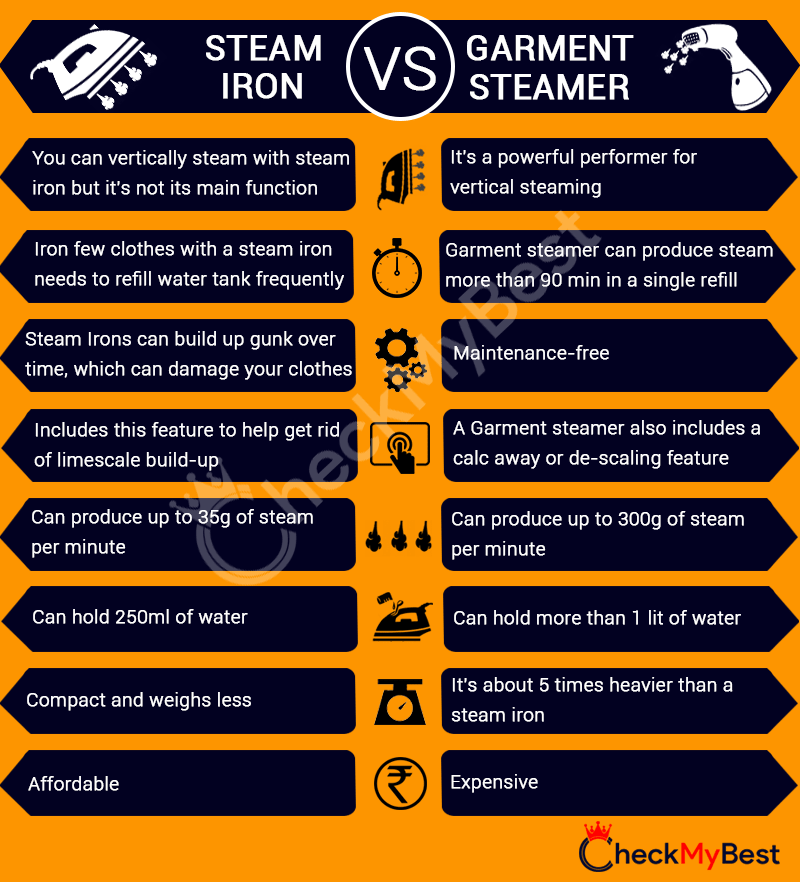
Both appliances share similar core features, but they’re built for two different jobs. Note that garment steamers vary a lot by type — a handheld steamer’s specs sit much closer to an iron’s than a full-size standing steamer’s do, so we’ve broken that out below.
| Feature | Steam Iron | Handheld Garment Steamer | Standing Garment Steamer |
|---|---|---|---|
| Typical Price (India) | ₹1,000 – ₹5,000 | ₹1,500 – ₹3,500 | ₹3,500 – ₹15,000 |
| Wattage | 1200W – 2400W | 1000W – 1800W | 1500W – 2000W |
| Steam Output | ~15–30 g/min | ~18–30 g/min | 100+ g/min (continuous) |
| Water Tank | 150 – 400 ml | 85 – 380 ml | 800 ml – 1.5 L |
| Preheat Time | 30 – 90 seconds | 30 – 60 seconds | 2 – 4 minutes |
| Needs Ironing Board | Yes | No | No |
| Vertical Steaming | Possible, not primary use | Yes, primary use | Yes, excels at this |
| Weight | Light (1 – 2 kg) | Light (~0.5 – 1 kg) | Heavier, floor-standing |
| Best Finish | Crisp, pressed look | Relaxed, wrinkle-free look | Relaxed, wrinkle-free look |
🤔 Who Should Buy Which?
You Want a Crisp, Office-Ready Finish
If you don’t have a huge pile of clothes to handle every week and mainly need a sharp, professional press for office shirts, formal trousers, or school uniforms, a steam iron is the right call. It’s compact, easy to store in any Indian household — even a small rental or PG room — and doesn’t take up floor space.
You Manage a Large Wardrobe or Delicate Fabrics
If you’re handling a large volume of clothes regularly — think joint families, or households that entertain often — a garment steamer can genuinely change your routine. It’s also the safer, better choice for delicate or heavily embellished Indian wear: silk sarees, banarasi or kanjivaram weaves, chiffon dupattas, sequinned blouses, and bridal lehengas all hold up better under steam than under a hot soleplate. If you have a dedicated laundry area, a standing steamer is worth considering too.
Your Wardrobe Is Genuinely Mixed
Many Indian households end up owning both — a steam iron for daily office wear and school uniforms, and a garment steamer for festive silk, wedding season lehengas and sherwanis, and curtains that never fit under a hot iron anyway. Given handheld steamers now start around ₹1,500, this combination isn’t as expensive as it used to be.
❓ Frequently Asked Questions
1. Are garment steamers better than steam irons?
Neither is strictly “better” — they solve different problems. A steam iron has a hot soleplate that gives you a crisp, pressed look, while a garment steamer relaxes fabric and removes wrinkles without direct pressure, which suits delicate and heavily embellished fabric better.
2. How do you use a garment/clothes steamer correctly?
Always use a garment steamer in an up-and-down motion with the head upright. Never tilt it head-down for extended periods, as this can cause hot water (not just steam) to leak out and stain or scald the fabric.
3. Which fabrics should not be steamed or ironed with steam?
Avoid steaming suede and waxed fabrics — the heat and moisture can damage or melt the coating. Always check the fabric care label first if you’re unsure of the material, especially with synthetic blends common in Indian festive wear.
4. Can I leave my garment steamer switched on unattended?
No. Even with auto shut-off features on many modern models, it’s best not to leave any heating appliance running unattended — the risk of fire or damage isn’t worth it, however brief the task feels.
5. Why is my garment steamer leaking water?
Leaks are usually caused by overfilling the tank. Hold the steamer head upright and let any pooled water drain back down through the hose before use, and avoid filling past the marked maximum line.
6. How do I unclog or de-scale a garment steamer?
Fill the tank with a mix of water and white vinegar, let it sit, then run and empty it as usual. Repeat if needed. This is especially useful in Indian cities with hard tap water, where mineral buildup happens faster — using filtered or distilled water going forward helps prevent it recurring.
7. Does hard water affect steam irons and steamers differently in India?
Both are affected similarly — hard water causes limescale buildup in the heating chamber over time in either appliance. Using filtered, distilled, or boiled-and-cooled water extends the life of both, and models with a built-in self-clean or de-scale function (common above ₹1,800 for irons) make this much easier to manage long-term.
🧺 Which Should You Choose?
The right choice comes down to your budget and your actual ironing needs, not which appliance is objectively “better.” If you want a crisp, professional finish for daily office wear and don’t mind an ironing board, a steam iron remains the simpler, cheaper option. If your wardrobe leans toward delicate or embellished fabric — silk sarees, chiffon, bridal wear — or you’re managing laundry for a large household, a garment steamer is worth the extra spend.
Before you decide, write down a quick checklist of what you actually iron most often, how much you’re willing to spend, and how much storage space you have. That’ll tell you more than any spec sheet. For a closer look at specific models and prices, check out our full guides to the best steam irons in India and the best garment steamers in India.
⚠️ Prices and specifications mentioned are approximate, based on typical Indian market listings as of 2026, and can vary by brand, retailer, and season. Always check current pricing and specs on the retailer’s page before purchasing.

Leave a Reply